Goal 3: Controlling students' noise levels
Page overview:
This page includes details on my third goal for this semester, including the purpose, plan, and evidence.
Teaching Competency: Managing Learning
SMART Goal
In order to make goals more attainable, a specific criteria must be followed, and this criteria uses the acronym SMART (Specific, Measurable, Attainable, Relevant, Time-based) (University of California, 2016).
Specific
To control students' voice levels in the classroom during the lesson.
Measurable
Check how many students remember to follow the rules regarding voice-levels during each section of the lesson.
Attainable
-
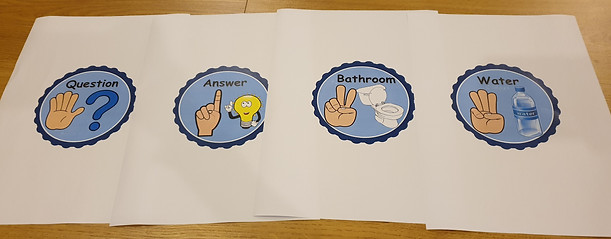
Introduce hand signals for when students need something, instead of voicing out their requests.
-
Use voice-level charts (0-4) and remind students which voice level we need to be at during different activities.
Relevant
Student's must maintain a specific voice-level within the classroom so other learners are not disturbed. Moreover, they are more likely to listen when I have something to say.
Time-based
Introduce the strategies earlier on (week 1 or 2) because students will need sufficient practice.
Justification
Not using explicit behavior management strategies has caused some trouble for me during lessons in the past. In addition, previous mentors commented on my need to improve my skills in managing behavior. For that reason, I set the goal to use strategies that I believe would help in behavior management. Furthermore, based on behaviorist B.F. Skinner’s theory of reinforcement, it is believed that using positive reinforcement increases the likeliness of rules being followed (O. Omomia & T.A. Omomia, 2014). Therefore, feedback will be given to students on their behavior and the ones who do well will be rewarded.
Previous Mentoring School Teacher (MST)'s Comment

My previous MST commented on my need to use classroom management strategies, which is why I believe this is a valid, and relevant goal in my teaching career.
Teaching Philosophy
Feedback shouldn't be restricted to academic performance, but can also target behavior in the classroom. I believe that feedback is a suitable way to let students know whether they are showing the desired behavior, or not. Thus, feedback also plays an important role in behavior management.
Find my teaching philosophy by clicking the following button:
Goal Implementation Steps
Step 1: Show mentor a strategy sample
I shared my ideas with my mentor, and explained what I planned on doing to control students' voice levels in the class.

Step 2: Begin modelling the strategies
I hung the posters, and charts where students can see them in the classroom.
I modelled how the hand signals should be used.
During activities, I introduced the voice-level charts in which students must maintain a specific voice-level depending on the activity type.

Step 3: Implementing the strategies

Alongside the hand signal rules, I attached small lights above the voice-level charts, and turned on the light that was above the level required for the activity; this raised students' awareness of what voice-level they must maintain.
Evidence of Progress
Strategy 1: Hand Signals
Strategy 2: Voice-level Chart


Using hand signals to indicate what requests students want to make was a successful strategy that shows how behavior management can be done through implicit means, as opposed to explicit ones.
During activities, students were meant to abide by the voice level assigned. For example, some activities require silence, others require a moderately loud voice, while presenting requires a speaker voice. This strategy did not work as well as I would have liked, since constant reinforcement was needed. I did not continue to remind students of the voice level after telling them at the beginning of the activity, which in turn, made them forget to keep abiding by that level.
Feedback
Mentoring School Teacher (MST)

My MST commented on my ability to create a safe, positive learning environment.

At the end of the placement, I was told by my MST that rules must be reinforced and firmly stated; and so I need to work on being strict with rules.
Mentoring College Teacher (MCT)

My MCT saw that I was able to manage the classroom well, but pointed out that I needed to consistently model and re-establish rules.
Reflection
Reflecting on this goal, there were some positive results, and other areas for development. One thing I did well was spacing out my introduction of the two main strategies, and giving students ample time to adjust to them. The error I made was not reinforcing the rules often enough, which causes students to not follow them well.
Read my reflection during teaching practice by viewing week 2 on my weekly reflection page by clicking on the button below:
References:
Omomia, O. A., & Omomia, T. A. (2014). Relevance of Skinner's theory of
reinforcement on effective school evaluaution and management [PDF].
European Journal of Psychological Studies, 4(4), 174-180.
https://doi.org/10.13187/ejps.2014.4.174
University of California. (2016). SMART goals: A how to guide. Retrieved April
29, 2020, from https://www.ucop.edu/local-human-resources/_files/
performance-appraisal/How%20to%20write%20SMART%20Goals%20v2.pdf